
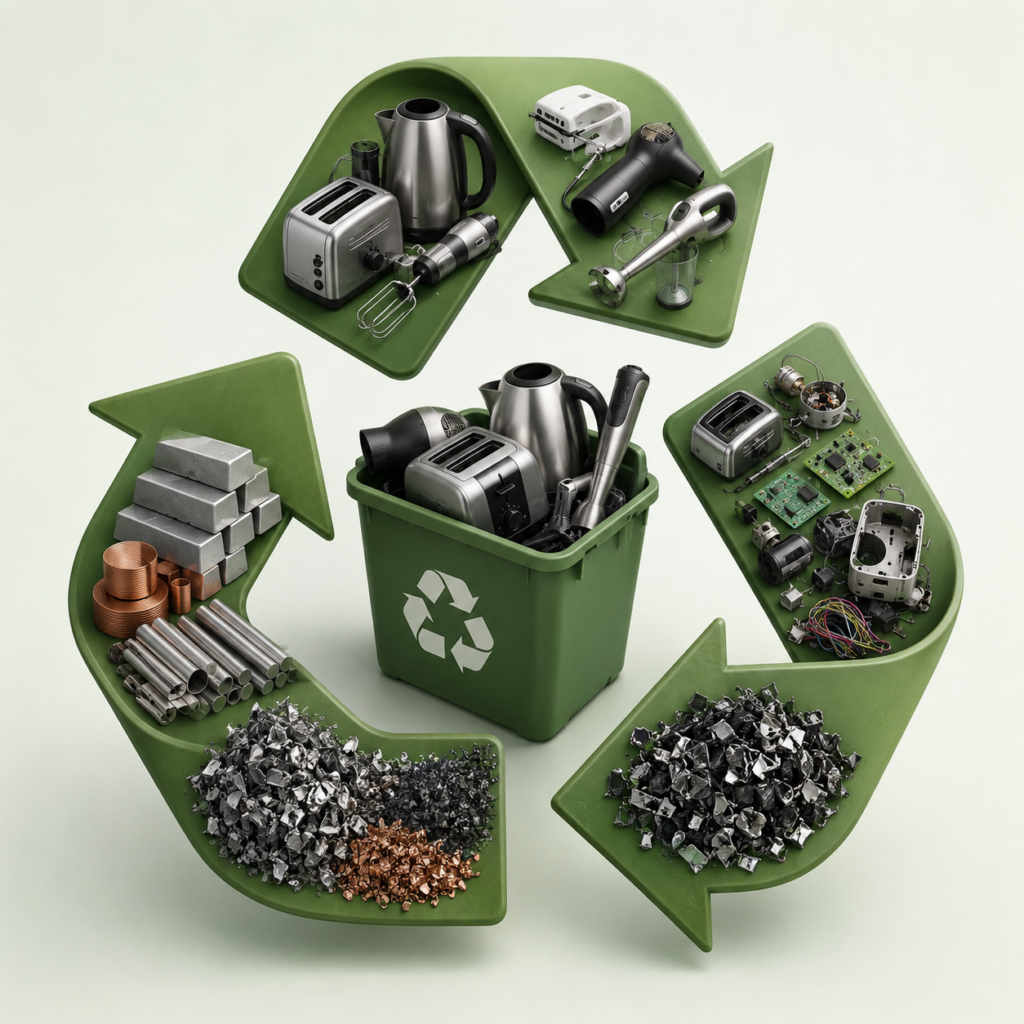
Italy continues to trail the European average when it comes to collecting and recycling small household electrical and electronic equipment. Although collection rates have improved in recent years, the country still faces significant challenges due to an insufficient collection infrastructure and limited public awareness of proper disposal practices.
These are the main findings of a study conducted by ReMedia and GfK Eurisko in collaboration with ReMade in Italy and Assoraee, examining consumer behaviour, collection performance and the environmental and economic benefits of recycling small household electrical appliances (SHAEE).
In 2010, approximately 37,000 tonnes of small electrical appliances were collected and sent for recycling in Italy, compared with more than 220,000 tonnes placed on the market. The collection rate reached 16.8%, representing a 21% increase over the previous year. However, it remained well below both the national average for Waste Electrical and Electronic Equipment (WEEE), which stood at 26%, and the European average, where one kilogram of electronic waste is collected for every four kilograms sold. In Italy, the figure falls to one kilogram collected for every six purchased.
The survey found that around half of Italian consumers purchased at least one small electronic device over the previous 12 months, while more than one-third disposed of at least one appliance. Nevertheless, fewer than half of those who discarded an item followed the correct recycling process by taking it to an authorised collection centre or using dedicated take-back services.
A major obstacle remains the uneven availability of collection facilities. While northern Italy offers a network that is close to European standards, central and southern regions have only 0.3 collection centres per 10,000 inhabitants, limiting access to proper WEEE recycling.
The “one-for-one” take-back scheme, which allows consumers to return an old appliance free of charge when purchasing a new one, is also significantly underused. Only a small percentage of consumers reported using this service, indicating that awareness of the initiative remains limited.
The research also highlights a substantial information gap. Three out of four Italians are unfamiliar with the meaning of the WEEE acronym, while only 17% say they know the regulations governing electronic waste management. Despite this, more than half of respondents believe they are adequately informed about the correct disposal procedures, revealing a clear mismatch between perceived and actual knowledge.
The environmental and economic benefits of recycling
Based on 700 interviews representative of Italy’s adult population, the study estimates that around 19 million people disposed of at least one small electrical appliance during the year. Of these, only 42% adopted environmentally responsible practices, while many either kept unused devices at home or disposed of them with general household waste.
From an industrial perspective, information technology and telecommunications equipment—including computers, printers, telephones and fax machines—accounted for roughly two-thirds of the total volume collected. Small household appliances and consumer electronics followed.
The environmental and economic benefits of recycling are substantial. Of the 37,000 tonnes collected, approximately 34,000 tonnes of materials—92% of the total—were successfully recovered. Iron and plastic represented the largest material streams, while valuable metals such as copper, aluminium, silver, gold and palladium were extracted from electronic boards and cables.
According to the study, the recovered raw materials generated an estimated economic value of €23.6 million. Recycling activities also saved more than 26,000 tonnes of oil equivalent (toe) and prevented the emission of around 54,000 tonnes of carbon dioxide. These environmental gains could increase significantly if collection rates improve and more consumers correctly recycle their end-of-life electrical appliances.